
Demand for high-purity quartz is growing in semiconductor manufacturing, solar technology, optical materials and specialty glass. Yet natural quartz rarely meets the requirements of these applications without processing. Iron-bearing minerals, mica, feldspar, clay and trace elements can affect product quality, and some impurities are difficult to remove even when the raw material has a high SiO₂ content.
The main challenge in quartz sand beneficiation is identifying how impurities occur and selecting the right combination of separation methods—scrubbing, magnetic separation, flotation and acid leaching each target different contaminants. The process route must match the deposit's mineralogy and the final product's specifications.
Quartz deposits can contain several types of impurities, and their occurrence determines how readily they can be removed.
Clay and iron-bearing films may coat quartz grain surfaces. Mica and feldspar can occur as separate particles or remain intergrown with quartz. Other impurities, including aluminum and titanium, may occur in associated minerals, fluid inclusions or within the quartz crystal structure.
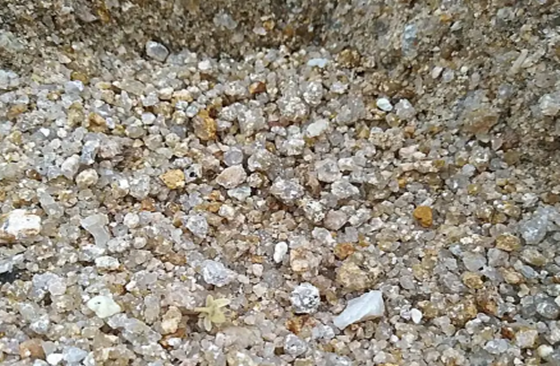
Surface contaminants and liberated mineral grains are generally more accessible to beneficiation. Impurities locked within quartz grains are harder to remove and may require additional treatment. This is why a high silica content alone does not establish whether a deposit can produce quartz sand for a particular application.
Chemical and mineralogical analyses help identify the main contaminants and guide the selection of suitable separation methods.
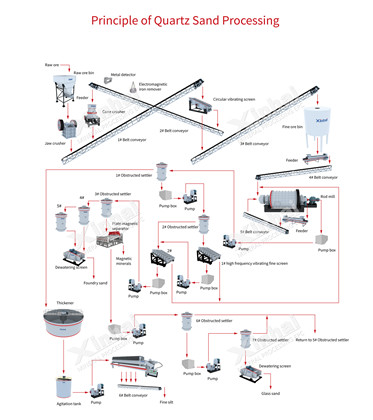
A quartz sand processing plant may combine several operations, depending on the feed material and target product quality. A typical flowsheet starts with washing and scrubbing, followed by classification and selected separation stages. More demanding applications may require chemical purification.
1. Scrubbing, Washing and Desliming
Scrubbing uses mechanical friction to loosen clay, iron-bearing films and other contaminants from quartz grain surfaces. Washing removes the loosened material, while classification and desliming separate fine particles from the sand.
Removing slimes before downstream treatment helps reduce interference during magnetic separation and flotation. However, scrubbing cannot remove impurities that remain locked within quartz grains.
2. Magnetic Separation for Iron Removal
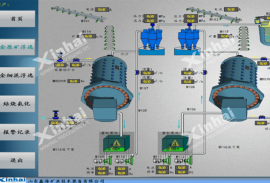
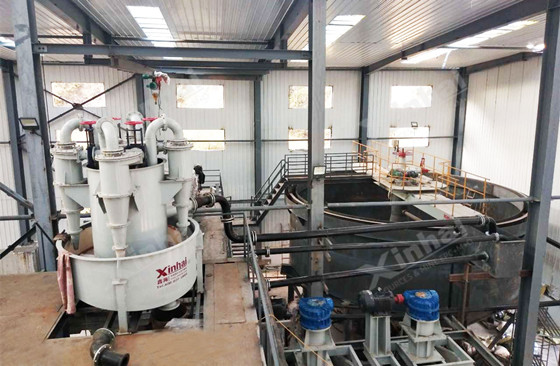
Magnetic separation removes iron-bearing minerals according to their magnetic properties. Low-intensity magnetic separators are suitable for strongly magnetic minerals, while high-intensity or high-gradient separators can target certain weakly magnetic impurities.
The choice depends on the minerals present in the feed. Magnetic separation works best when iron occurs as discrete, magnetically susceptible grains. Iron locked within quartz or present in certain surface coatings may remain after this stage, requiring further treatment if the product specification demands lower iron levels.
3. Flotation to Remove Mica and Feldspar
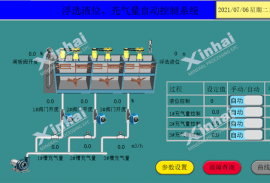
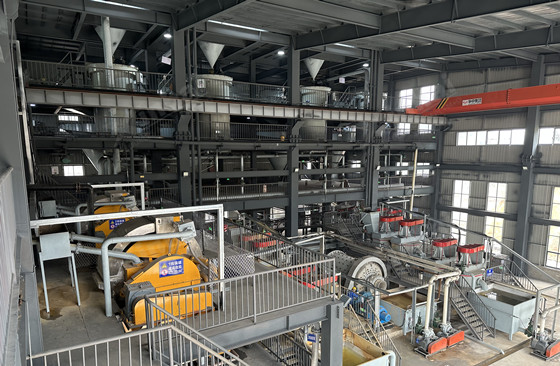
Flotation separates minerals through differences in their surface properties. With appropriate reagents and operating conditions, it can remove mica, feldspar and other associated minerals from quartz sand.
Depending on the mineral assemblage, the process may use direct flotation, reverse flotation or multiple flotation stages. Selecting suitable flotation equipment and optimizing reagent conditions are essential to achieving effective separation. The equipment configuration and operating parameters should be determined through beneficiation tests.
Flotation is particularly useful when washing and magnetic separation alone cannot remove enough of the associated silicate minerals to meet the target specifications.
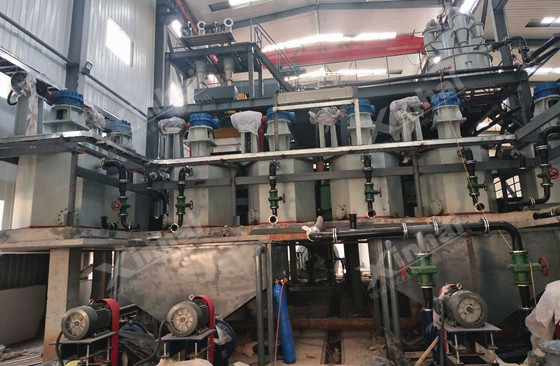
4. Acid Leaching for Further Purification
Acid leaching is considered when physical separation leaves residual impurities above the required limits. Under suitable conditions, chemical treatment dissolves certain metal-bearing contaminants, particularly those exposed on grain surfaces or accessible through pores and fractures.
Results depend on impurity mineralogy, particle size, acid composition, temperature, and treatment time. Impurities enclosed within quartz grains or incorporated into the crystal structure can be much harder to remove.
Before adding acid leaching to a quartz sand beneficiation flowsheet, test work should establish whether the improvement in product quality justifies the additional reagent, water-treatment and waste-management costs. Chemical treatment also requires appropriate controls for reagent handling, wastewater and residues.
Some demanding applications require further purification beyond conventional beneficiation. Depending on the raw material, pretreatment such as calcination and water quenching may help expose certain inclusions and make some impurities more accessible to subsequent treatment.
These methods are not necessary for every deposit, and they do not guarantee the removal of all internal impurities. Their value must be demonstrated through testing against the required product specifications.
Quartz deposits vary widely in mineral composition, impurity content and liberation characteristics. A suitable flowsheet must be developed around the specific feed and the quality requirements of the intended market.
Start with the raw material. Chemical analysis and mineralogical examination identify the main impurities, while particle-size and liberation studies help determine which separation methods are likely to work.
Define the product requirements. The target SiO₂ content, iron and other impurity limits, particle-size range and end use establish the performance criteria for the plant. Glass-grade silica, photovoltaic-related materials and semiconductor applications can have substantially different specifications.
Verify the separation performance. Laboratory beneficiation tests help compare scrubbing, magnetic separation, flotation and leaching options. Pilot testing may be needed to confirm the proposed flowsheet, evaluate operating conditions and provide data for engineering design.
Assess operating costs and environmental controls. Equipment investment, energy consumption, reagent use, water recycling and wastewater treatment all affect project feasibility. Chemical purification, in particular, should be evaluated alongside its treatment and waste-management requirements.
Xinhai Mining has more than 20 years of experience in quartz processing equipment and flowsheet development. Its approach starts with the characteristics of the raw material and the quality requirements of the finished product.
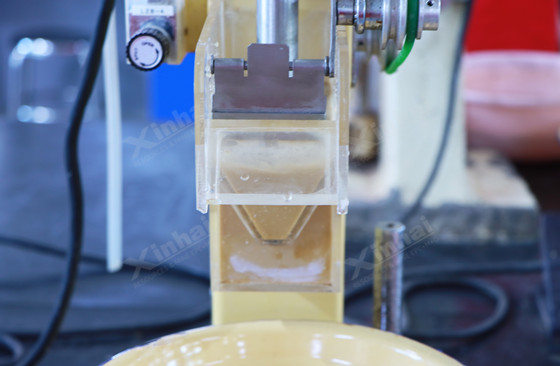
Laboratory beneficiation tests help identify suitable separation methods and measure impurity removal. Where the results need further verification, pilot testing can provide additional data for flowsheet selection and plant design. This process helps determine the appropriate combination of equipment and treatment stages for each project.
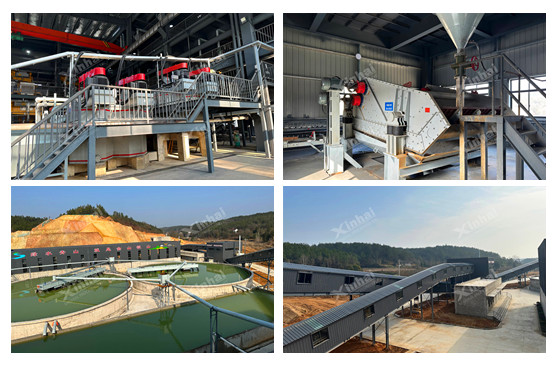
Xinhai has delivered quartz sand processing projects ranging from 30 t/d ultrapure quartz sand lines to 3,000 t/d low-iron, high-purity quartz sand operations. These projects represent different production scales and processing requirements; the appropriate configuration depends on the feed characteristics and target product specifications.
For quartz producers evaluating a new project or upgrading an existing plant, the first step is to establish what the raw material can achieve. Reliable sample analysis and beneficiation test results provide the technical basis for selecting a process route, configuring equipment and assessing project feasibility.
Scrubbing can remove some iron-bearing surface coatings, while magnetic separation targets susceptible iron-bearing minerals. Acid leaching may be used to reduce certain residual impurities when physical methods are insufficient. The appropriate combination depends on how the iron occurs in the feed.
Yes. Flotation can remove mica, feldspar and selected associated minerals when their surface properties allow effective separation from quartz. Reagents and operating conditions must be matched to the mineralogy of the feed.
No. Some deposits can meet their target specifications through physical beneficiation alone. Acid leaching is considered when residual impurities remain above the required limits and test results support further chemical treatment.
Key inputs include representative ore samples, chemical and mineralogical analyses, feed particle-size distribution, target product specifications, production capacity, water availability and environmental requirements. These data help engineers develop a suitable flowsheet and evaluate project feasibility.
Share your project details and our engineers will get back to you shortly.
 CHAT
CHAT MESSAGE