
On the northeastern edge of the Qaidam Basin, a gold mine is being expanded at elevations where construction is measured against the calendar as much as against the drawings. The freezing season runs from October to the end of April. The coldest month, January, averages −12.4 °C, frost penetrates 1.7 m, and winds reach 40 m/s. It is here that Xinhai Mining has completed the main civil works of a tailings facility — the structure that will receive the concentrator's tailings for the next decade, and the one whose performance is judged not at commissioning but over years of groundwater records. This article describes what was built, in what scope, and to what specification.
The facility serves a gold mine in Qinghai Province, in a high-altitude mountain area where the property spans 3,085 m to 4,039 m above sea level. The regional climate is dry and windy: the annual mean temperature is 0.1–1.8 °C, the freezing season stretches from October to late April, and the maximum frost depth reaches 1.7 m. Every construction decision on this site — fill scheduling, compaction control, the sequencing of remaining works — is shaped by those numbers, because the window for earthworks in dependable conditions is the warm half of the year.
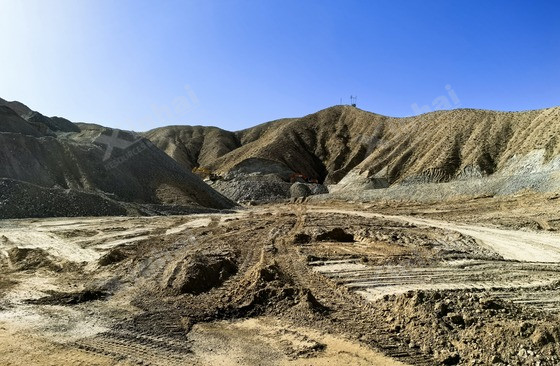
Site panorama: dam foundation and reservoir area under excavation on the Qinghai Plateau.
Altitude also raises the environmental stakes. Plateau groundwater systems are thin, slow-recharging and ecologically sensitive, which is why the seepage design — not just the dam's stability — became the defining requirement of this project.
The facility is a hillside-type impoundment built as a single-stage dam, with wet tailings disposal and a downstream embankment. Total storage capacity is 643,200 m³, with a design service life of about 9.87 years receiving gold tailings. Both are design figures: they describe what the facility is engineered to hold and for how long, not an operating result.
The preliminary design was prepared by the owner's design institute. Xinhai's scope covers two roles: the construction drawings, produced by Xinhai's design institute, and the civil construction itself. That includes site clearing; the embankment works; seepage control and seepage drainage; the flood control works; the civil portion of the safety-monitoring facilities, such as the concrete works for displacement observation points, dam-slope steps and geotextile bags; and the auxiliary works — the access road, duty room, pump house, stilling basin and the impoundment-area safety fencing.
Stating the boundaries plainly: the complete equipment package, the automated dam-safety monitoring instruments, and the eventual closure design are outside this scope. What Xinhai delivers here is the engineered structure and its civil works, built to the construction drawings it also produced.
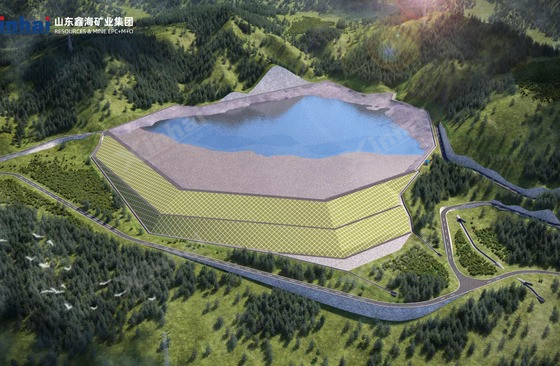
Design rendering of the tailings facility — not an as-built view.
Embankment stability in this terrain starts below the fill. The dam foundation was excavated down to stable bedrock before fill placement began, removing the weathered and loose material that would otherwise compress or slide under the embankment's weight.
Above the foundation, quality was written into the construction specification itself. Geogrid reinforcement is laid every 4 m of fill to raise the embankment's overall shear resistance; compaction degree is tested every 0.5 m of placement, so that each lift is verified before the next one covers it. On a single-stage dam this discipline is not bureaucratic — there is no later raising campaign in which to correct a weak layer built today.
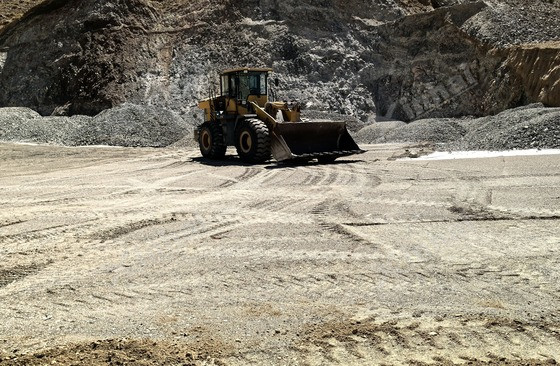
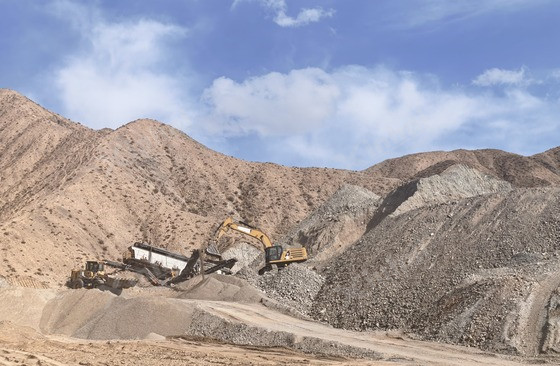
Dam foundation fill: the embankment is built in compacted lifts, each tested every 0.5 m.
The ground made that discipline expensive to keep. The rock around the site is hard: excavation rates dropped, and equipment failure rates rose in consequence. The site's response was organizational rather than technical — operators assigned full-time to their machines, a maintenance crew resident at the mine with replacement buckets and tires on hand, scheduled servicing kept current, and additional excavators brought in with loading points and haul routes re-arranged so that the daily fill supply for dam construction never ran dry. It is an unglamorous chain of measures, and it is the kind that decides whether a specification survives contact with a schedule.
The seepage control system is built up as six distinct layers, each with a defined duty:
① a sodium-bentonite GCL, which swells to a low-permeability barrier on contact with water; ② geotextile, protecting the liner layers from puncture; ③ a geomembrane, the principal impermeable sheet; ④ a composite drainage net, which intercepts and conducts seepage away rather than letting it build pressure; ⑤ a rockfill prism at the downstream toe, collecting seepage for controlled discharge; and ⑥ a cut-off wall keyed into the foundation, limiting under-seepage along the base of the dam.
Groundwater observation wells complement the system, so that seepage conditions can be tracked and managed against the water table the design set out to protect. The combination is what allows a wet-disposal facility to operate above a sensitive plateau aquifer: containment and drainage working together, rather than either alone.
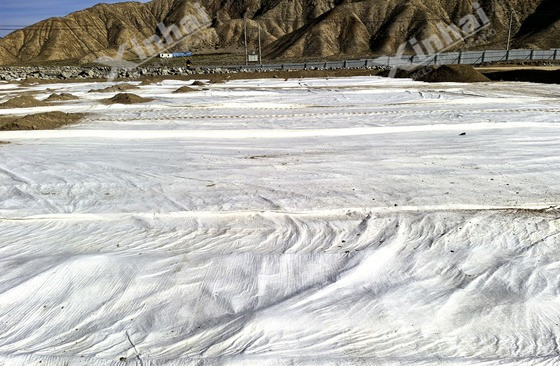
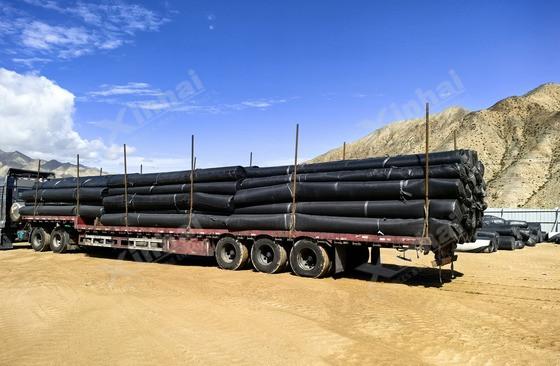
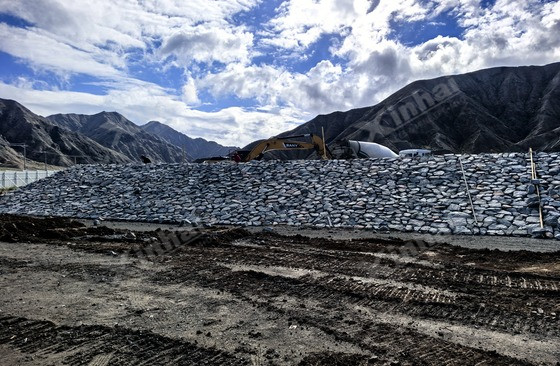
Geotextile placement — the protection layer of the six-layer seepage control system.
A tailings facility in this region faces two flood regimes, not one: summer rainstorms and the spring snowmelt that comes off the high ground as temperatures rise. The flood system is therefore arranged as a complete chain — a spillway; interception ditches along the dam abutments; drainage ditches across the site; a stilling basin that dissipates the energy of concentrated flows; and a return-water barge that manages water recovery from the pond. Each element handles one leg of the flow path, and the design assumption is that both seasons arrive every year.
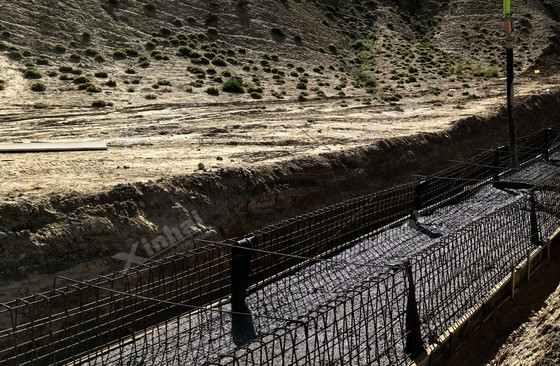
Reinforcement and formwork along a longitudinal drainage channel of the flood control system.
None of the above executes itself at 3,000-plus metres. Normal-period staffing on the tailings works ran at about 40 people, peaking at 90 during the intensive campaign. High-altitude sites lose workers faster than lowland ones, and an unstable crew shows up directly in fill quality — new hands, repeated briefings, uneven compaction. The project stabilized its workforce through multi-channel local recruitment: community networks in the surrounding area, local job platforms, and referrals from experienced workers already on site. The same logic runs through the safety routine — daily site inspections, a hazard ledger with named owners and deadlines for every finding — because a workforce that stays is also a workforce that can be trained to a consistent standard.
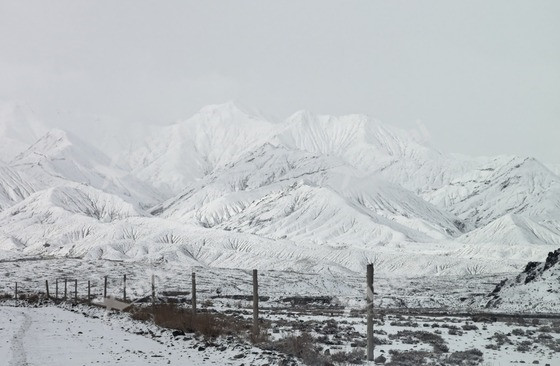
The site under snow — the freezing season here runs from October to late April.
Work on the facility started under the notice to proceed issued on 14 July 2026. Main civil works are now complete. Two items remain, and their timing is deliberate: the safety fencing awaits the owner's confirmation of the layout before installation, and revegetation — grass seeding across the disturbed areas — is scheduled for the next warm season, when germination and establishment are actually possible. Seeding into frozen ground in October would spend money to grow nothing. On this site, the calendar is part of the engineering.
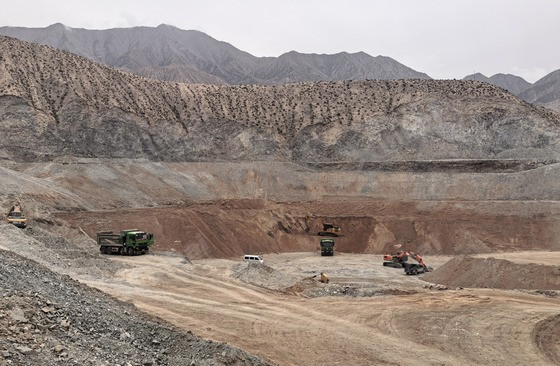
Embankment fill and haulage in progress, August 2026.
The measure of a tailings dam is not the day the fill reaches design height. It is the groundwater record ten years later — which is why the seepage system, not the embankment's silhouette, is the part of this project built to be quoted.
Planning a tailings facility at high altitude or in an ecologically sensitive area?
Xinhai Mining provides tailings facility construction-drawing design and civil construction under the EPC+M+O service framework. Contact us to discuss your site conditions, embankment configuration and seepage control requirements.
The construction drawings (by Xinhai's design institute) and the civil works: site clearing, the single-stage embankment, seepage control and seepage drainage, flood control works, the civil portion of safety-monitoring facilities, and auxiliary structures including the access road, duty room, pump house, stilling basin and safety fencing. The complete equipment package, the automated monitoring instruments and the closure design are outside this scope.
It is a hillside-type impoundment with a single-stage dam, wet tailings disposal and a downstream embankment. Total storage capacity is 643,200 m³ and the design service life is about 9.87 years, receiving gold tailings. Both are design values.
Through a six-layer system — sodium-bentonite GCL, geotextile, geomembrane, composite drainage net, rockfill prism and cut-off wall — complemented by groundwater observation wells to track seepage conditions.
The embankment was founded on stable bedrock, reinforced with geogrid every 4 m of fill and compaction-tested every 0.5 m, with construction sequenced around a seven-month freezing season. The site did not present permafrost or frost-heave conditions; these methods address cold climate and altitude, not permafrost engineering.
Share your project details and our engineers will get back to you shortly.
 CHAT
 MESSAGE