
A gold mine in China wanted more tonnage out of its main shaft. The conventional answer is a bigger hoist — a major purchase and, in most cases, a long production outage. Before going down that road, the mine turned to Xinhai Design Institute, the design institute of Shandong Xinhai Mining Group, with a different brief: take 4,200 t/d as the target, and work out what it would actually take to get there. This article follows that project from the first verification study to the completed construction drawings.
Xinhai Design Institute set one premise before any analysis started: the existing hoisting facilities and hoisting equipment would not be changed. That premise does two things. It protects the owner's installed investment, and it forces the study to look for capacity inside the system rather than outside it.
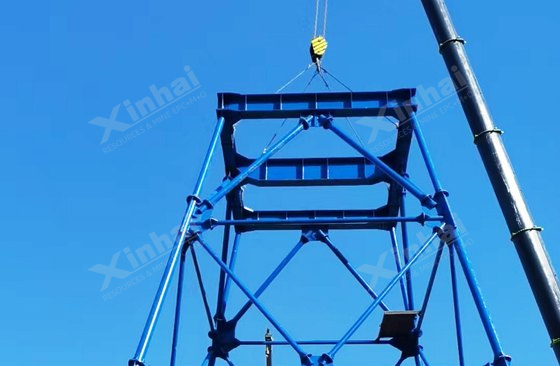
Erecting a steel headframe at a mining engineering EPC project undertaken by Xinhai in Hebei, China.
Within that premise, the first job was a capability verification — a condition survey of the hoisting system, a bottleneck analysis, and a check of what the system can actually reach at 4,200 t/d. The point of this stage is to produce a verified statement, not a wish: where the system stands today, which nodes constrain it, and what optimizing those nodes is worth. Only when that statement is on the table does the question of new investment arise, and it gets answered against evidence.
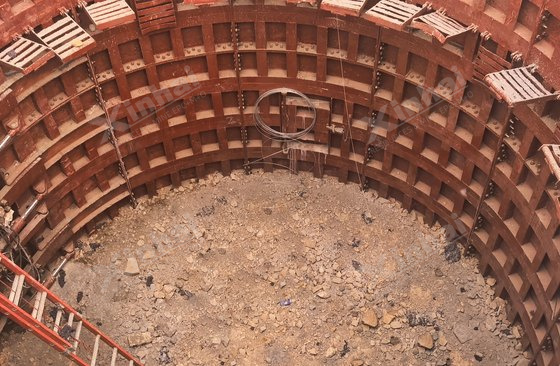
Inside the shaft during sinking at the Hebei mining engineering project: the condition of the shaft itself is where every capability verification starts.
One constraint stood out from the verification: the run-of-mine ore coming out of the underground stopes was too coarse. Oversized lump slows every cycle it touches, so no amount of node optimization would deliver the target unless the size problem was solved at the source.
The answer was a new underground crushing system, designed to match underground discharge lump size, crushing configuration and hoisting capacity as one set. That match is also why the project needed the team it had: mining machinery, shaft construction and electrical engineers from Xinhai Design Institute worked on it together, so the crushing design and the hoisting design were checked against each other by the people writing both.
One scope note for readers: this is a mine hoisting, transport and underground crushing system retrofit — a mining design. It is a separate matter from the surface plant's crushing and screening circuit, and the two should not be conflated when reading the project.
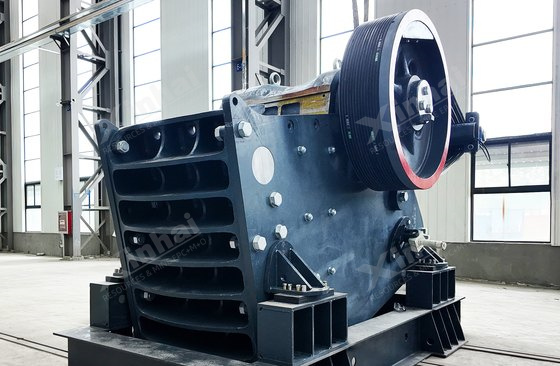
A jaw crusher completed in Xinhai's manufacturing workshop
The project ran in three stages, and the dates are part of the story. Design started on 4 May 2023. The feasibility study — the stage where the verification results and the optimization schemes are argued through — was submitted on 1 July 2023. Construction drawings were completed and submitted on 15 August 2025.
Each stage ended with its own deliverable, which means the owner could stop, pause or continue at every boundary with evidence in hand. The staged structure also keeps the work honest: the capability verification from stage one is the same document that the feasibility study argues from, and the construction drawings implement what the feasibility study fixed. Nothing in the chain rests on assertion alone.
Two years and three months is the design period of this project. It is not a construction period, and it is not a production downtime estimate — the plant keeps operating while the design work proceeds.
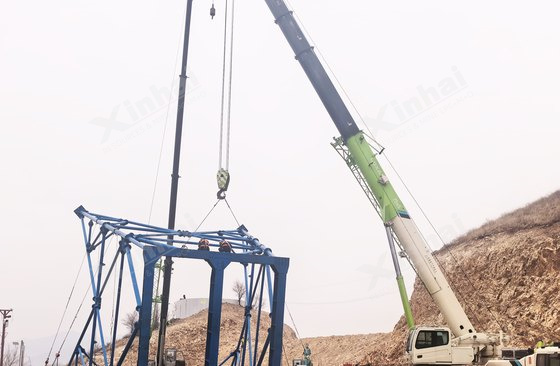
Headframe erection in progress at the Hebei project — staged work where each stage ends with its own deliverable.
The pattern in this project is repeatable: a fixed target, a no-replacement premise, a verified bottleneck statement, and a staged path from verification to construction drawings. If your shaft is the bottleneck, send Xinhai Design Institute your shaft parameters, hoisting configuration and current hoisting rate. The first step is a capability verification, not a purchase order. And because design is only the first link: where a project continues, Xinhai can connect it to equipment manufacturing, installation and operation services as one supplier. If the constraint sits at the surface plant rather than the shaft, see our companion article on retrofitting an existing gold plant with pre-concentration and equipment reuse.
No. 4,200 t/d is the capability verification and design target for the shaft system, not an achieved or stable hoisting output. Actual output depends on construction, commissioning and operating conditions after the design is implemented.
No. Both the capability verification and the design proceed on the premise that the existing hoisting facilities and hoisting equipment are not changed. Capacity is pursued by optimizing the constraint nodes of the system and matching upstream lump size.
Underground crushing addresses the match between run-of-mine lump size and hoisting capacity — a mine hoisting and transport problem. It is a separate matter from the plant's surface crushing and screening circuit.
Condition survey, bottleneck analysis, scheme argumentation and equipment capacity verification. The output is a verified statement of what the existing system can achieve and where its constraints are, which feeds directly into the feasibility stage.
Share your project details and our engineers will get back to you shortly.
 CHAT
 MESSAGE