
What does a complete gold processing plant look like, from crushing to bullion, and what determines the size of each stage?
Seven stages, in the same order on almost every gold plant: crushing and screening, grinding and classification, gravity recovery if the ore justifies it, leaching and adsorption, desorption and electrowinning, smelting, and tailings with water recovery. The sequence is settled engineering. The numbers behind it are not. Grindability sets the crushing and grinding duty. Gold grain size and occurrence set the grind and decide whether a gravity circuit pays for itself. Cyanide consumers and preg-robbing carbon decide the leach route, and whether anything has to happen to the pulp before cyanide goes in. Two criteria settle most arguments: where the ore carries natural carbonaceous matter, leach and adsorb in the same tanks (CIL), so engineered carbon is present from the first minute; where soluble copper is present, wash it out before leaching.
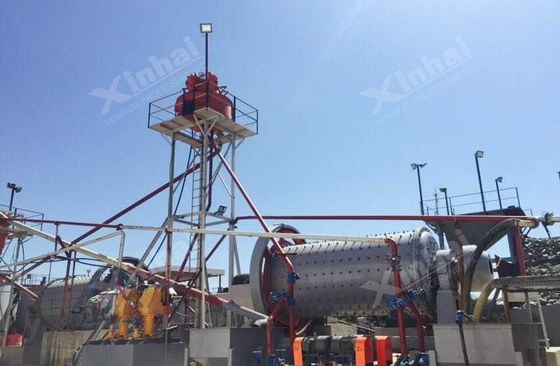
Site panorama of a gold processing plant built by Xinhai Mining.
| Stage | Job | Design inputs | Typical configuration (case basis) |
|---|---|---|---|
| Crushing and screening | Get run-of-mine ore down to a mill feed size | Ore hardness, Bond work index, clay content | Three-stage closed circuit, product −8 mm |
| Grinding and classification | Liberate the gold-bearing minerals | Gold grain size, target liberation | Two-stage closed circuit, 95% passing 0.074 mm |
| Gravity pre-recovery (optional) | Catch liberated coarse gold before it recirculates | Presence of coarse free gold | Knelson concentrator plus shaking table, inside the grinding circuit |
| Leaching and adsorption | Dissolve gold, load it onto carbon | Preg-robbing carbon, soluble copper, pulp density | Pre-leach plus nine stages of continuous leach; leach rate >94%, adsorption >98% |
| Desorption and electrowinning | Strip gold off loaded carbon into sludge | Loaded carbon grade, carbon type | About 150 °C, 0.5 MPa, 12–15 h |
| Smelting | Take out impurities, pour bars | Sludge impurity profile | Bullion above 95% gold |
| Tailings and water | Dewater, stack, recycle | Settling and filtration behaviour, permits | Dry stacking with filtrate recovery, closed water circuit |
The values in that table (−8 mm, 95% passing 0.074 mm, >94% and >98%, 150 °C at 0.5 MPa for 12–15 h) are the published configuration of a 1,000 t/d plant in Mongolia. They describe the ore and the design. Read them as an example, not as a specification.
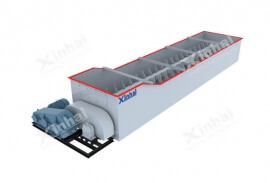
Jaw or gyratory for primary, standard cone for secondary, short-head cone closed with screens for tertiary. On the Mongolian ore, the product ran at −8 mm. One choice matters more than it looks on gold: where the rock is high in silica and abrasive, put a cone crusher at the secondary stage, not an impactor. Blow bars in silica-rich rock disappear faster than a maintenance budget expects. Closing the circuit buys a steadier, finer mill feed and less over-crushing. Reducing feed P80 by 1 mm typically saves 3–5% in ball mill specific energy, which on a large plant is worth arguing about.
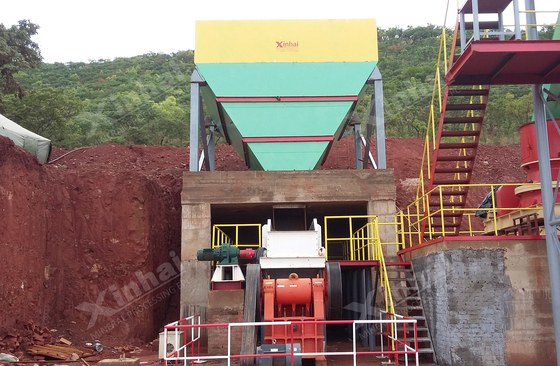
Jaw crusher and feed bin at a gold plant crushing section in Zimbabwe.
A primary wet overflow ball mill closed with hydrocyclones: underflow back to the mill, overflow to pre-leach. The Mongolian plant grinds to 95% passing 0.074 mm, which is about where cyanide leaching becomes practical. Classification equipment decides how much over-grinding you pay for. Spiral classifiers recover 30–60% of the fines and suit coarser cuts. Hydrocyclones reach 60–90% and suit fine cuts, at the cost of sensitivity to feed density and pressure, and an apex that wears. Those ranges are general industry experience; a plant's actual numbers come from testwork and the supplier's data.
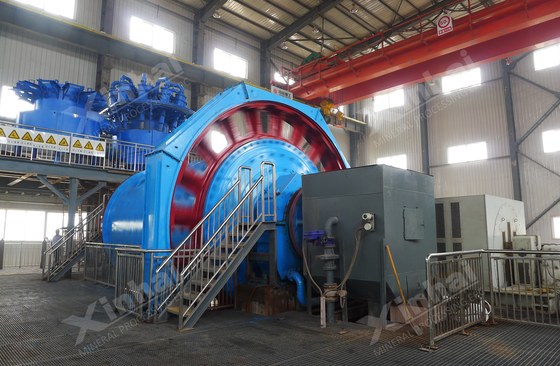
Overflow ball mill and hydrocyclones in the grinding section.
After pre-leach, the pulp runs through nine stages of continuous cyanidation, with high-efficiency thickeners and dual-impeller, hollow-shaft agitated tanks. The control window most plants work in: pH 10–11 on lime, which keeps hydrogen cyanide gas out of the workplace air; six to ten tanks in series; 24–48 h of leach and adsorption; pulp density around 40–50%. Conventional ranges again, and the project numbers come from testwork.
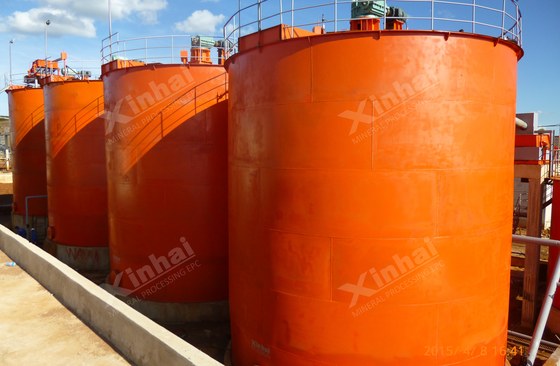
Leaching tanks under installation at a 1,200 t/d gold plant in Tanzania.
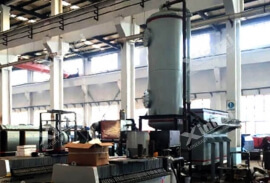
Loaded carbon is stripped and electrowon at roughly 150 °C and 0.5 MPa over 12–15 h, and the sludge goes to the furnace for bullion above 95% gold. Xinhai publishes its desorption electrolysis system at up to 150 °C and 0.5 MPa, typically 12 h, with no sodium cyanide in the strip solution, level and temperature control, automatic operation and three safety interlocks.
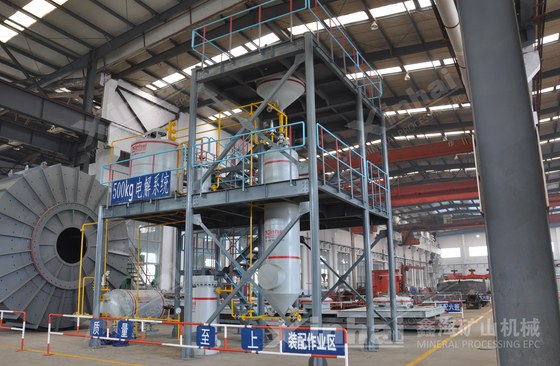
Complete desorption electrolysis system, assembled in the workshop.
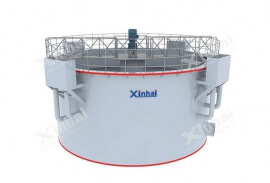
Dewater, stack dry, send the filtrate back. That closes the water circuit, and on an overseas project it also heads off two problems that surface later: water consumption, and the permit that follows it. Tailings dam design and siting sit with the civil and tailings disciplines and local regulation. Process configuration cannot settle them, and promising that it will is how projects get into trouble.
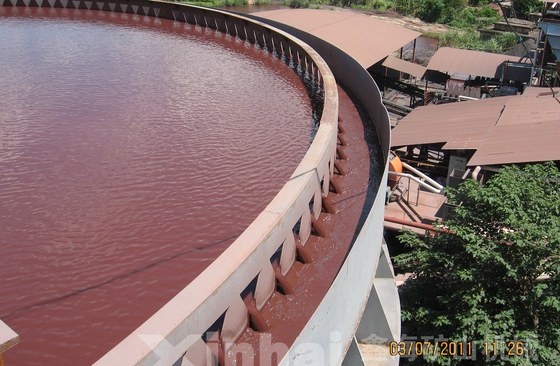
Tailings thickening and water recovery.
Once the backbone is fixed, the leaching route comes down to two questions about the ore.
Some deposits carry carbon in the host rock: graphite, organic carbon, bitumen-type matter. Chemically, it behaves much like the activated carbon a plant adds on purpose, with surface area to match and the same appetite for gold. Cyanide dissolves the gold, and the natural carbon takes it straight back onto the ore particle, which then reports to tailings. The assay looks fine. The recovery does not, and the tailings grade runs high for no obvious reason. The effect is called preg-robbing, and the culprit is called preg-robbing carbon.
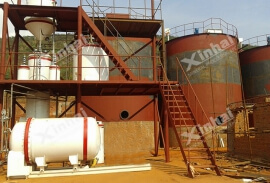
The remedy is to have engineered carbon in the tank before the natural carbon can do its work. In CIL, carbon goes into the same tanks where leaching happens, so adsorption starts the moment dissolution does. Activated carbon competes with the natural carbon on capacity and wins, taking dissolved gold into its pores; loaded carbon is screened out and sent to the strip circuit. In CIP, carbon goes in after leaching finishes. Cheaper and simpler on clean ore, and the wrong call on carbonaceous ore: by the time carbon is added, the natural carbon has had the entire leach residence time to take the gold. Same chemistry, different timing; on preg-robbing ore, timing is recovery.
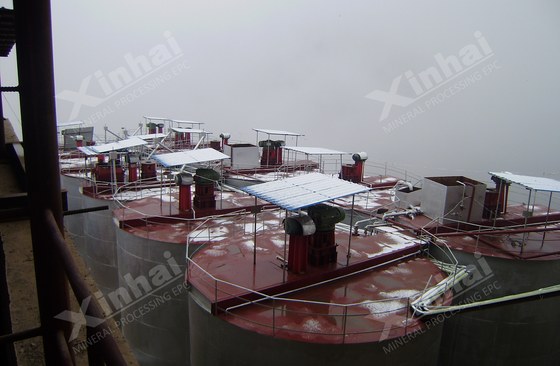
Leach-adsorption tank array at the Wenxian Xin'guan 1,000 t/d CIL gold plant.
Copper dissolves ahead of gold in cyanide. Feed a copper-bearing ore straight to leach and the cyanide goes to copper first, the pregnant solution picks up copper, reagent consumption climbs, and solution grade falls. The fix is unglamorous and effective: a washing circuit ahead of leaching, to take soluble copper out before cyanidation begins.
Seven stages, unchanged, and the plant still failed. A 3,000 t/d operation in Guinea, built by Xinhai Mining under an EPC+M+O contract, shows how far the configuration has to move when the ore changes.
The ore is lateritic: 80% clay, 28% natural moisture, and plenty of free particulate gold. The client had already run a conventional hard-rock flowsheet in trial production. Wet clay at 28% moisture does not crush. It packs. Chambers plug, screens blind, the plant stops, and recovery sat below 70%. The failure is not mysterious once the configuration logic is applied. A conventional crushing and grinding section is built for hard, low-clay feed. Free gold, meanwhile, was already liberated at coarse sizes, so every hour in the grinding circuit made it finer and pushed more of it toward the tailings.
Three changes followed.
Wash and de-slime first. The first unit is a washing plant, not a crusher. Clay leaves the circuit as slurry, and downstream equipment passes the tonnage it was sized for.
Grind with gravity inside the circuit, so liberated free gold is caught while it is still coarse, and coarse and fine gold are recovered in separate steps.
Leach the gravity tailings in CIL for the fine gold.
The plant went up as a modular steel structure rather than conventional civil works, which suited the local infrastructure. On stable operation, recovery moved from below 70% to above 92%, reagent consumption dropped 18% year on year, and the blockage stoppages that had plagued trial production stopped. Modular construction cut capital cost by 50% against conventional build and reached full production in eight months.
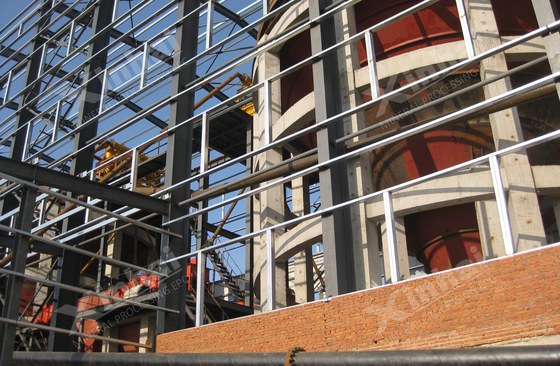
Modular steel-structure plant under construction.
The first step in configuring a plant is not drawing a flowsheet. It is pulling a representative sample and running metallurgical testwork, answering four questions: how hard is the ore (Bond work index), how coarse is the gold (size distribution), where does the gold sit (free, locked, encapsulated, solid solution), and what will eat the reagent (copper, arsenic, carbon, sulphur). Those four answers fix the crushing and grinding duty, the grind size, whether gravity is worth building, and the leach route. Everything downstream follows.
Doing that properly takes capability at both ends. Xinhai states its position without much decoration: no design without a test report. The report decides the process route, the equipment and the core parameters. It is not a reference document to be consulted when convenient. The company's research institute runs a CNAS-accredited laboratory that tests gold, copper, nickel and lithium ores, among others. Design sits in an institute of six departments and eighteen disciplines, covering mineral processing, civil, power, automation and steel structure, with more than twenty professional software systems in use, including SolidWorks 3D design, BIM coordination, GEOVIA and PKPM. Conventional, mobile and modular steel-structure plants all come out of the same office.
Seven boxes are easy to copy. The numbers are the work. Skip the testwork, borrow a flowsheet from a similar project, and the bill arrives after startup, when it is expensive.
If you are weighing a gold project or planning a plant, start with a sample and a test programme, and let the numbers choose the flowsheet. Reach us and we will review the testwork and configuration with you.
No. Each one is a result for a particular ore, a particular flowsheet and a particular point in time. It does not mean that any plant configured this way will reach 92%. Guarantees belong in the contract, with an agreed method for measuring them.
Because the flowsheet follows the testwork, not the commodity name. A laterite at 80% clay and 28% moisture separates from a hard, low-clay ore at the first crusher. Preg-robbing carbon decides CIL or CIP. Soluble copper decides whether a washing circuit goes in ahead of the leach tanks.
Share your project details and our engineers will get back to you shortly.
 CHAT
 MESSAGE