
What determines whether a tungsten concentrate meets its specification, and why is a 65% WO3 assay not enough?
An assay of 65% WO3 by mass does not, by itself, show that a shipment meets its product specification. YS/T 231-2015 — China’s industry standard for tungsten concentrate — covers product classification, chemical composition, moisture, particle size, appearance, test methods and inspection rules. It does not set prices. The requirements used to assess a shipment depend on the applicable standard and the terms agreed by buyer and seller. Pricing coefficients, deductions and discounts are commercial terms.
This article explains how product specifications, impurity control and contract terms relate to process design. It does not provide a universal price formula or guarantee that a particular ore can meet a given specification.
An assay describes a tested sample. A product specification defines the requirements that apply to a product variety and a shipment. In practice, three layers should be kept distinct:
| Layer | What it covers | What it does not determine |
| Product standard | Product varieties, technical requirements, test methods and inspection rules | Prices, deductions or which standard edition the parties adopt |
| Contract | Applicable standard and variety, additional technical conditions, and lot, sampling and retest procedures | The standard’s published technical limits |
| Commercial terms | Price basis, deductions and the price or rejection consequences of a failed retest | Whether the material meets the technical requirements |
YS/T 231-2015 classifies tungsten concentrate by mineral type and chemical composition. Its listed varieties include premium grade, Grades I–V, mixed tungsten concentrate and tungsten slime. The standard record identifies YS/T 231-2015 as issued on April 30, 2015, effective October 1, 2015, and replacing YS/T 231-2007. View the official standard record.
Publicly available text of the standard describes tungsten slime as material finer than 0.074 mm, with a WO3 mass fraction of 20%–40%. It also gives moisture limits of 2.0% for wolframite concentrate and 3.0% for scheelite concentrate, a particle-size limit of 9 mm except for tungsten slime, and an appearance requirement against foreign matter. The applicable grade and impurity limits vary by product variety. For a purchase or sales decision, check the official standard text and the variety and edition specified in the contract; the public record page provides publication details, not the full technical clauses.
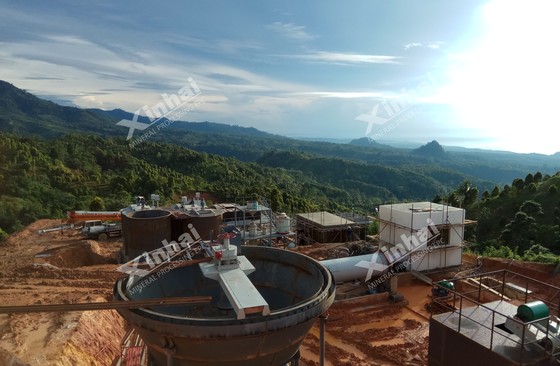
(Mineral processing plant with thickening and agitation equipment on a hillside site)
A grade table describes product requirements, not what a particular ore can produce. Establishing achievable grade and recovery requires testwork on a representative sample. Likewise, a single assay result does not establish whether an entire lot passes: the contract and applicable inspection procedure determine how the lot is sampled, tested and assessed.
A penalty element is a constituent that a buyer limits because it can affect downstream processing. The mineral carrying an element matters as much as its measured concentration. For example, an arsenic assay alone cannot show whether arsenic occurs in liberated arsenopyrite that may be removed by sulfide flotation, or in locked particles that may require further liberation. Process mineralogy helps distinguish these cases.
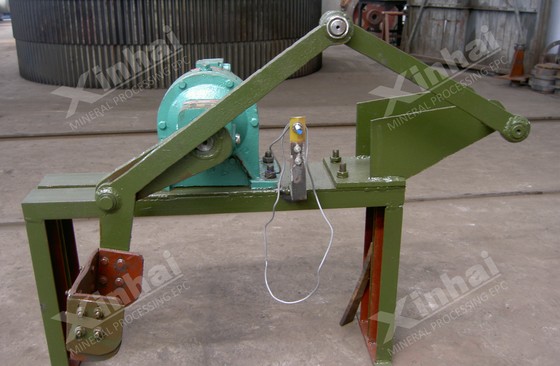
(Dry ore sampler for batch sampling and assay)
The table below gives possible control points, not general process recommendations. The effect of any stage depends on the carrier mineral, liberation, grind size and reagent regime, and must be tested for the ore in question.
| Carrier minerals or source | Elements of concern | Possible control point (ore-dependent) |
| Sulfides such as pyrite, arsenopyrite, chalcopyrite and molybdenite | S, As, Cu, Mo, Bi | Sulfide flotation ahead of tungsten recovery, where the minerals are sufficiently liberated |
| Apatite, xenotime and monazite | P | Selective depression or, where mineral response supports it, electrostatic separation |
| Cassiterite | Sn | Magnetic or electrostatic separation, if testwork confirms a useful response |
| Calcite, fluorite and other Ca-bearing gangue | CaO and related components | Scheelite flotation selectivity, where the reagent system permits |
| Water in filter cake | Moisture | Thickening and dewatering; cake moisture is a process result, while the limit is a product requirement |
Upgrading can involve trade-offs. Regrinding may improve liberation while increasing the fine fraction, which can be difficult to recover. Tighter depression may affect recovery. If physical separation cannot meet a limit, an additional operation such as roasting may be considered, subject to energy, emissions and project requirements. The grade–recovery trade-off must be measured on the project’s own sample.
Xinhai’s related articles discuss scheelite process selection and wolframite and scheelite beneficiation.
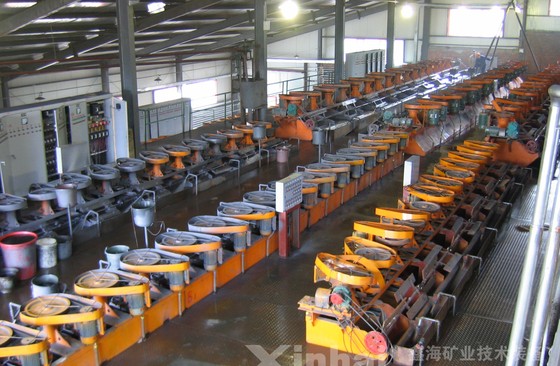
(Rows of flotation cells in a concentrator building)
A product standard does not set the purchase price. Published research describes WO3 grade and impurity levels as factors that may affect pricing coefficients and deductions, but commercial terms are agreed between buyer and seller. This article does not provide coefficients, deduction amounts or a price formula. Contract discussions may cover the price basis, treatment of off-specification material and the commercial consequences of retesting.A laboratory study illustrates the technical side. For one scheelite ore with a feed grade of 0.27% WO3 by mass, the reported closed-circuit test results changed from 53.11% WO3 at 89.22% recovery to 66.18% WO3 at 89.80% recovery after reagent optimization. The authors also describe the site concentrate as having a low pricing coefficient because of its grade. These are results for one ore and test program, not a design value, commercial formula or plant guarantee. Read the study.
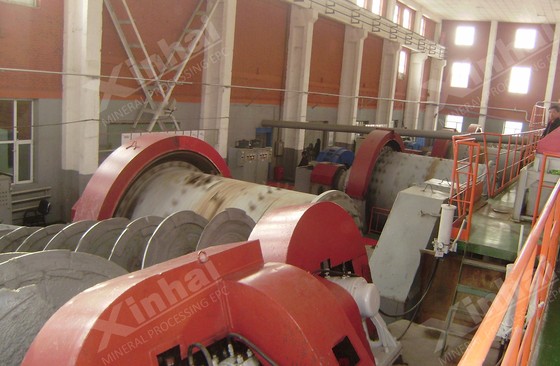
(Two ball mills in a grinding circuit inside a mill building)
Before setting a target grade or writing it into a contract, ask for:
Process mineralogy: Which minerals carry As, P, S, Sn and Ca-bearing components, and how well are they liberated at the proposed grind?
Locked-cycle testwork and full assays: What WO3 grade, impurity profile and recovery are achievable on a representative sample?
Grade–recovery data: What recovery and circuit-complexity trade-offs come with targeting a higher grade?
Physical-condition results: What moisture and particle-size results can the proposed dewatering and handling stages deliver?
Clear contract terms: Which standard edition and variety apply, and how are lots sampled, inspected and retested?
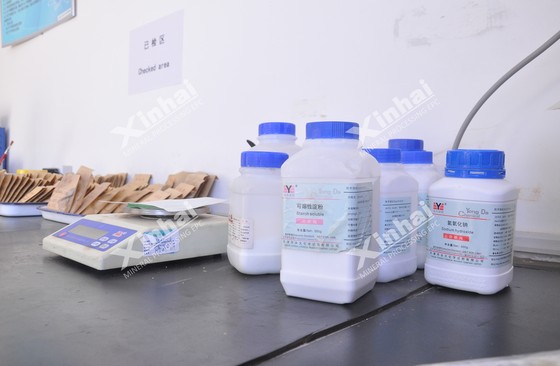
(Laboratory bench with balance, reagents and prepared samples for assay)
General industrial indices used in resource assessment are not concentrate product specifications. They should not be used as substitutes for the product standard or the project’s contractual requirements.
Xinhai provides metallurgical testwork, process design, equipment manufacture, and plant construction and operation services for tungsten and polymetallic ores. A product specification should be set using testwork on the project’s own sample; results from another ore are not a guarantee.
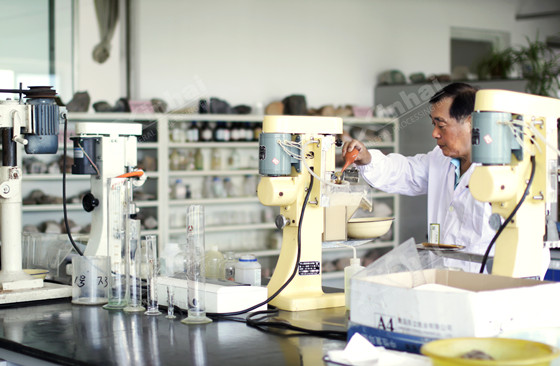
(metallurgical lab assay)
No. WO3 is one part of a product specification. Assessment can also depend on impurity limits, moisture, particle size, appearance, product variety, the applicable standard edition, and the contract’s lot inspection and retest procedures.
No. It covers product classification, technical requirements, test methods and inspection rules. Pricing coefficients, deductions and the commercial consequences of a failed retest are agreed between buyer and seller.
No. It is a laboratory closed-circuit result for one ore. The reported recoveries were 89.22% and 89.80%, respectively; results at another operation will depend on its ore and process conditions.
Share your project details and our engineers will get back to you shortly.
 CHAT
 MESSAGE