
As high-grade wolframite resources continue to dwindle, scheelite (CaWO₄) has stepped up as a major tungsten source. That said, processing scheelite is noticeably trickier than wolframite. It’s brittle, generates a lot of slimes during grinding, and often hangs out with calcium-rich gangue minerals like calcite and fluorite. These similar surface properties make clean separation a real challenge if you want high WO₃ recovery.
This guide walks you through how to pick the most suitable scheelite processing method based on your actual ore characteristics — and when it makes sense to use gravity separation, flotation, magnetic separation, or a smart combination of them.
Before selecting equipment or designing a scheelite processing plant, the first question should be: What type of scheelite ore are you processing?
In practice, three mineralogical factors determine the most suitable scheelite beneficiation flowsheet.
Liberation Size
Liberation size is one of the most important parameters affecting scheelite recovery.
Coarsely liberated scheelite can often be recovered efficiently through gravity separation, while finely disseminated scheelite generally requires flotation to achieve acceptable metallurgical performance.
Associated Gangue Minerals
The abundance of calcite, fluorite, and other calcium-bearing gangue minerals has a significant influence on scheelite flotation.
Since these minerals exhibit surface properties similar to scheelite, selective calcite separation and fluorite separation become the primary challenges during beneficiation.
Deposits with high calcite or fluorite contents usually require optimized depressant systems or heated flotation.
Associated Valuable Minerals
Many tungsten deposits contain both wolframite and scheelite, while others are associated with pyrrhotite, molybdenite, chalcopyrite, or other sulfide minerals.
For these complex ores, a combined tungsten ore processing flowsheet generally delivers higher concentrate grades and better overall recovery than any single beneficiation method.
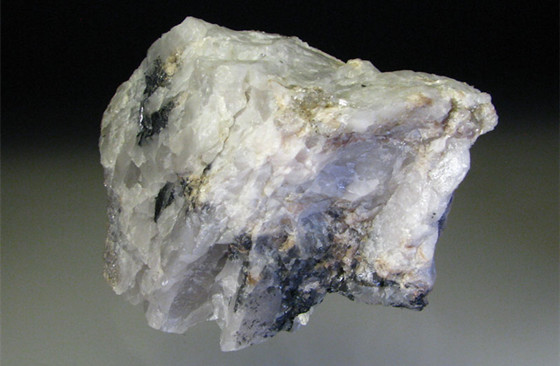
Scheelite Ore Characteristics and Their Impact on Beneficiation
Scheelite (CaWO₄) has a specific gravity of approximately 5.8–6.2 g/cm³ and is commonly found in skarn, greisen, and hydrothermal vein deposits.
Typical associated minerals include garnet, diopside, wollastonite, calcite, fluorite, pyrrhotite, chalcopyrite, sphalerite, and molybdenite.
One of the defining characteristics affecting scheelite beneficiation is its brittleness. During grinding, scheelite readily produces fine slimes that coat mineral surfaces, increase reagent consumption, and reduce flotation selectivity.
For this reason, grinding, classification, and desliming are critical steps in every scheelite ore processing plant.
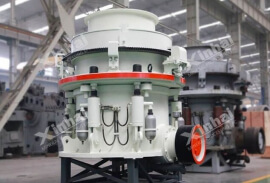
Industrial operations generally use jaw crushers and cone crushers for crushing, followed by ball milling to achieve approximately 60–80% passing 200 mesh.
Hydrocyclones or spiral classifiers are then used for classification, while ultrafine particles below approximately 10 μm are commonly removed before flotation to improve recovery and reduce reagent consumption.
Gravity separation is primarily used as a pre-concentration stage in scheelite processing.
By taking advantage of the density difference between scheelite and gangue minerals, gravity separation removes a large proportion of waste rock before flotation, thereby reducing downstream operating costs.
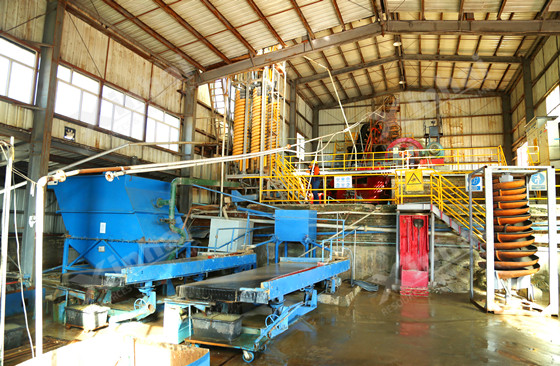
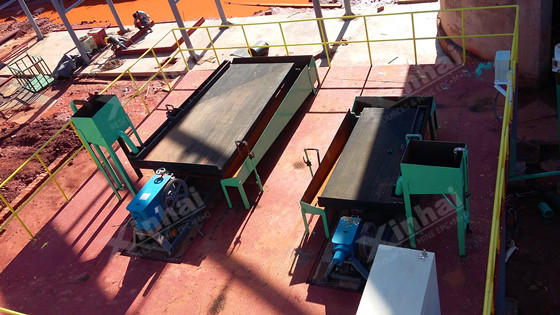
(Gravity separation equipment for scheelite processing)
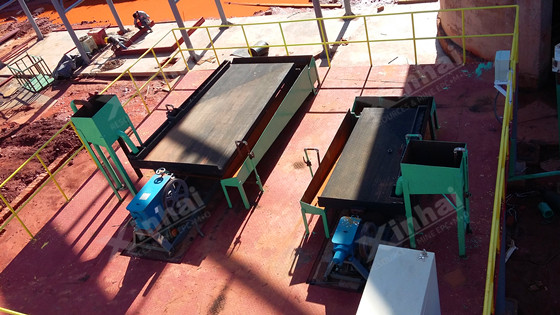
Typical gravity separation equipment includes:
Jig machine
Spiral chutes
Shaking tables
Gravity separation is particularly suitable for coarse scheelite recovery. Since scheelite is prone to slime generation, desliming before gravity separation is generally recommended. Tailings from gravity circuits often contain fine scheelite particles and are therefore normally treated by flotation for additional recovery.
For fine-grained deposits, scheelite flotation remains the most important stage of the entire scheelite beneficiation process.
The greatest technical challenge is not collecting scheelite—it is separating scheelite from calcite and fluorite.
Because all three minerals contain calcium, conventional fatty acid collectors tend to float them simultaneously. Consequently, flotation performance depends primarily on the effectiveness of the depressant system rather than the collector itself.
A typical industrial scheelite flotation process includes:
Pulp pH adjustment to 9.0–10.5 using sodium carbonate or sodium hydroxide
Sodium silicate as the primary depressant
Auxiliary depressants such as quebracho extract, tannins, or phosphates
Fatty acid collectors including oleic acid, sodium oleate, tall oil, or oxidized paraffin soap
Heated Flotation for High-Calcite Scheelite Ores
When calcite and fluorite contents are particularly high, conventional flotation often cannot achieve acceptable tungsten concentrate grades.
Under these conditions, the Petrov Process (heated flotation) is widely adopted.
The rough concentrate is thickened to approximately 60–70% solids, conditioned with sodium silicate, heated to 80–90°C, and subsequently diluted before cleaning flotation.
The heating stage promotes collector desorption from gangue minerals while maintaining adsorption on scheelite, making it possible to produce tungsten concentrates containing more than 65% WO₃.
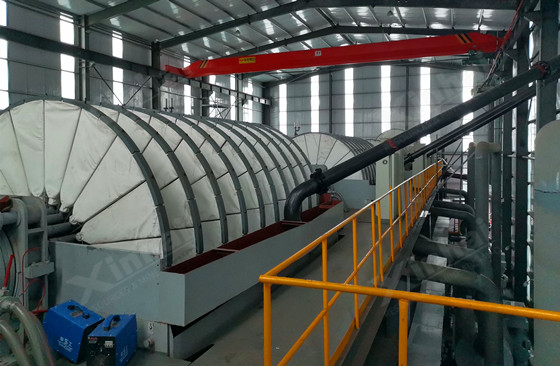
When magnetic gangue minerals such as pyrrhotite are present, high-intensity magnetic separation is frequently incorporated into the scheelite beneficiation flowsheet.
Following regrinding, magnetic separation removes iron-bearing minerals and significantly improves concentrate quality.
For many operations, concentrate grade can increase from approximately 50% WO₃ to over 65% WO₃ after magnetic cleaning.
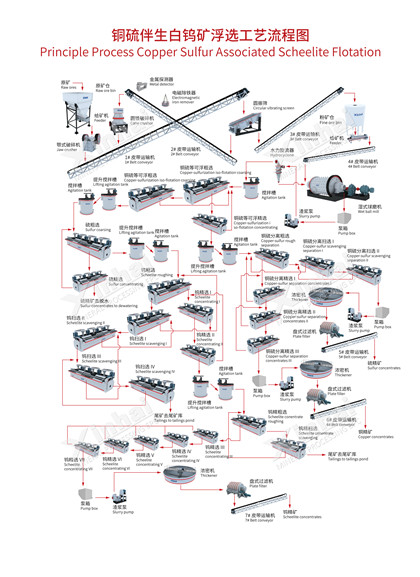
For deposits containing both wolframite and scheelite, the industry standard is typically a combined gravity separation + flotation + magnetic separation flowsheet.
The general process is:
Crushing → Grinding → Gravity Separation → Scheelite Flotation → High-Intensity Magnetic Separation → (Optional Electrostatic Separation)
This integrated tungsten ore processing flowsheet maximizes coarse wolframite recovery while maintaining excellent recovery of fine scheelite.
| Ore Characteristics | Recommended Scheelite Processing Method |
| Coarse scheelite | Gravity Separation + Flotation |
| Fine disseminated scheelite | Flotation |
| High calcite or fluorite content | Heated Flotation + Optimized Depressant System |
| Magnetic gangue minerals | Add High-Intensity Magnetic Separation |
| Wolframite–Scheelite associated ore | Gravity + Flotation + Magnetic Separation |
These recommendations provide general guidance only. Every scheelite processing plant should validate its flowsheet through laboratory testing, pilot testing, and comprehensive metallurgical testing before commercial operation.
Conclusion
Successful scheelite processing begins with understanding the ore—not copying an existing flowsheet. Even deposits with similar tungsten grades may require completely different scheelite beneficiation processes because of variations in liberation size, gangue mineral composition, and slime generation.
Comprehensive metallurgical testing should therefore be completed before process design. Grinding conditions, reagent schemes, equipment selection, and the final scheelite processing flowsheet should all be based on test results rather than assumptions.
A customized beneficiation solution not only improves WO₃ recovery and concentrate grade, but also reduces reagent consumption, lowers operating costs, and delivers more stable long-term plant performance.
Common causes include excessive slime generation, insufficient desliming, poor liberation, or an inappropriate reagent regime.
Calcite and scheelite possess similar surface chemistry, making selective flotation challenging without an optimized depressant system.
Scheelite is naturally brittle and readily overgrinds during milling. Optimizing grinding conditions and removing ultrafine particles before flotation are essential for maintaining flotation selectivity.
Most concentrators target approximately 60–80% passing 200 mesh, although the optimum liberation size should always be established through metallurgical testing.
Yes. For coarse-grained scheelite ores, gravity separation can reject a significant proportion of waste rock while reducing flotation costs and improving overall plant efficiency.
High-intensity magnetic separation is recommended whenever pyrrhotite or other magnetic minerals are present, or when further concentrate upgrading is required.
Share your project details and our engineers will get back to you shortly.
 CHAT
CHAT MESSAGE