
Scheelite is one of the world's most important tungsten minerals, but recovering it efficiently is rarely straightforward. In many deposits, scheelite occurs alongside calcite, fluorite, apatite, and sulfide minerals that respond similarly during flotation, making selective separation a major challenge.
This article explains the key challenges in scheelite beneficiation and the practical solutions used to improve tungsten recovery. It also covers the flotation process, reagent selection, equipment, and process optimization strategies for different ore types.
The beneficiation of scheelite stone is a key step in the tungsten extraction process. Its scientific soundness and rationality directly affect the subsequent tungsten recovery rate and product quality.
Scheelite is often found with various sulfide minerals, with molybdenite being particularly common. To prevent sulfide minerals from interfering with scheelite flotation, the general beneficiation process follows the principle of "floating sulfide minerals first, then floating scheelite." This preferential flotation process effectively separates sulfide minerals from scheelite, laying a good foundation for efficient scheelite flotation later.

Scheelite flotation is carried out in an alkaline medium. The pH of the pulp is a key factor affecting flotation performance. Sodium carbonate and sodium hydroxide are usually used to adjust the pulp pH to a range of 9-10.5. In this pH environment, scheelite maintains good floatability, while some gangue minerals are suppressed.
During flotation, depressants play a crucial role in improving selectivity. Commonly used depressants include sodium silicate (modulus 2.2-3), saponin gum, tannic acid, and various phosphates. The choice and dosage of depressants should be determined through beneficiation testwork, as different gangue mineral compositions require different reagent strategies.
Collectors are another important reagent in scheelite flotation. Commonly used collectors include oleic acid, sodium oleate, tall oil, and oxidized paraffin soap. These collectors have good surface activity, can selectively adsorb onto the scheelite surface, making it hydrophobic, and allowing it to attach to air bubbles and float. Fatty acid collectors remain the most widely used option for scheelite flotation, but their performance depends heavily on pulp chemistry, water quality, and associated gangue minerals.
It's worth noting that these collectors themselves have frothing properties, so usually no additional frother is needed in the actual flotation process. This simplifies the flotation process and lowers reagent costs.
Although scheelite ore has good floatability, actual ores often contain calcium-containing gangue minerals with similar properties, such as calcite, fluorite, and apatite. These gangue minerals have surface properties similar to scheelite, making them easily adsorbed by collectors, too. This complicates the flotation process and lowers the grade of the scheelite concentrate.
To solve this problem and improve flotation selectivity, a common and effective method is to add multivalent metal salts (like ferrous sulfate) to the sodium silicate. This combination significantly enhances the depression effect on calcium-containing gangue minerals without affecting the floatability of scheelite. This greatly improves scheelite flotation performance, yielding a higher-grade scheelite concentrate.
Furthermore, heating the pulp is also an important measure to improve scheelite flotation. The Petrov method is a classic example of using this principle. This method heats the pulp to 70-90°C while adding a large amount of sodium silicate. Although newer reagent systems are now widely used, the Petrov process remains an important reference for understanding selective depression in scheelite flotation.
Under the combined action of high temperature and abundant sodium silicate, the collector adsorbed on the calcite surface is desorbed. Calcite loses its floatability and sinks, while scheelite maintains good floatability and is selectively floated out. This further improves the separation effect between scheelite and gangue minerals.
The choice of extraction equipment is closely related to the scheelite beneficiation process. High-quality and suitable equipment ensures the smooth progress of the beneficiation flow and improves production efficiency. As a world-renowned mining equipment manufacturer and mining solutions provider, Xinhai Mining has a complete equipment line suitable for all stages of scheelite extraction. It can provide strong support for your scheelite project.
1. Crushing and Grinding Equipment
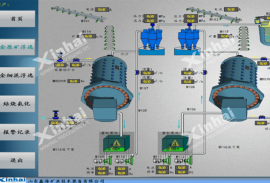
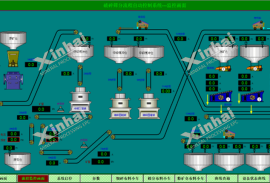
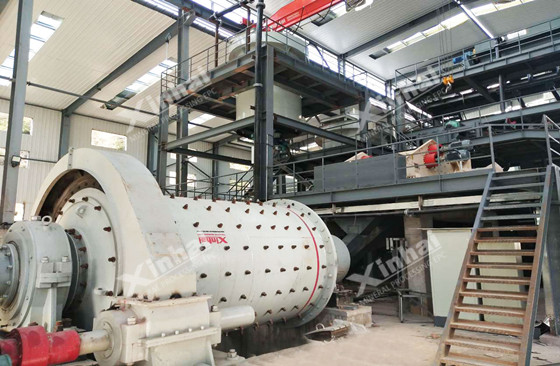
In the crushing and grinding stage, the first step in scheelite extraction, jaw crushers offer advantages such as a high crushing ratio, high crushing efficiency, and strong adaptability. They can effectively break large chunks of scheelite stone into small particles, meeting the requirements for the next process. Cone crushers are suitable for medium- to fine-crushing of scheelite. They operate smoothly with low noise and produce well-shaped crushed products, further improving the quality of the crushed ore. Ball mill grinder is used for the grinding operation of scheelite.
2. Flotation Equipment
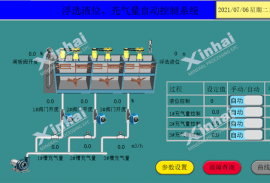
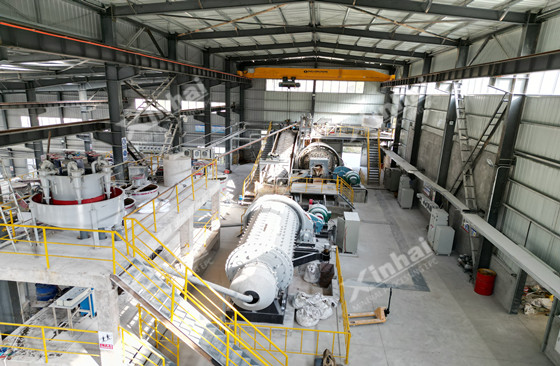
Stable air dispersion, effective reagent mixing and sufficient flotation residence time are essential for scheelite flotation. Xinhai's flotation machine is designed to meet these process requirements while adapting to different ore characteristics.

3. Thickening and Dewatering Equipment
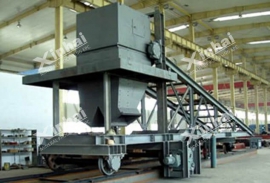
In the dewatering stage, press filter and centrifuges play important roles. Filter presses have high dewatering efficiency, producing filter cakes with a low moisture content. They effectively separate the solid and liquid phases in the scheelite concentrate, facilitating its storage, transportation, and further processing. Centrifuges are suitable for dewatering fine scheelite concentrates. They offer a fast dewatering speed, a compact structure, and easy operation, further enhancing the dewatering effect of the concentrate.
Additionally, Xinhai provides a range of auxiliary equipment, such as vibrating screens, spiral classifiers, and magnetic separators. These can be matched with the main equipment based on the actual needs of the scheelite extraction process to form a complete and efficient production line.
Conclusion
Every scheelite deposit presents different processing challenges. Ore mineralogy, gangue composition, liberation size and tungsten grade all influence the final beneficiation flowsheet. For this reason, Xinhai begins every project with beneficiation testwork before recommending process design, equipment selection and plant configuration.
Backed by nearly 30 years of mining experience, Xinhai Mining provides integrated EPC+M+O services covering metallurgical testing, engineering, equipment manufacturing, construction, commissioning and mine operation, helping clients improve recovery, reduce operating costs and maximize project value.
Because scheelite is commonly associated with calcite, fluorite and apatite, which have similar flotation properties.
Flotation is the primary beneficiation method, often combined with gravity separation depending on ore characteristics.
Selective depressants such as sodium silicate combined with optimized reagent schemes are commonly used to suppress calcite flotation.
Every scheelite ore has different mineralogical characteristics. Laboratory testwork helps determine the most suitable flowsheet, reagent scheme and equipment selection.
Share your project details and our engineers will get back to you shortly.
 CHAT
CHAT MESSAGE