
With fifteen years of experience in mineral processing, having managed hundreds of projects from alluvial gold operations in Ghana to vein gold mines in Peru, my deepest insight is this: there is no universal formula for gold beneficiation. However, gravity separation plays a crucial role in recovering coarse gold. Whether for large-scale alluvial gold concentration or the pre-recovery of coarse gold from hard rock ores, gravity separation holds an irreplaceable position in processing flowsheets due to its low cost, stable recovery rates, and environmental friendliness.
Drawing on years of field experience, this article shares key points of gravity separation for placer and vein gold deposits, equipment selection tips, and practical operational considerations.
From an ore characteristics perspective, most gold-bearing ores contain a certain proportion of coarse, free-milling gold, typically in the +0.1mm size range. These gold particles exhibit poor surface hydrophobicity, making them difficult to capture effectively with flotation reagents. Conversely, hydrometallurgical methods like cyanidation show extremely low leaching efficiency for coarse gold, often leading to incomplete dissolution.
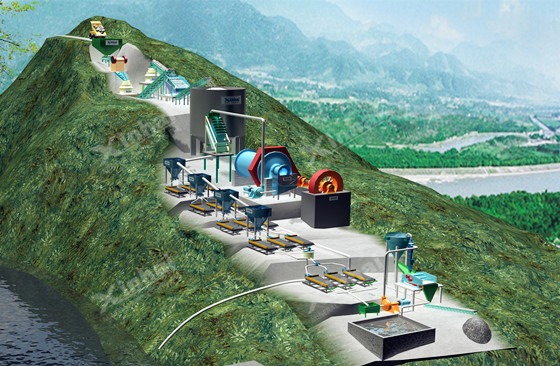
Gravity separation excels by leveraging the significant specific gravity (SG) difference between gold (SG ~19.3) and gangue minerals (SG typically 2.6-3.0), enabling efficient separation via a gravity field—an inherent advantage unmatched by flotation or cyanidation. Therefore, gravity concentration is widely used for processing placer gold and for recovering liberated coarse gold from hard rock ores, either before or after flotation and leaching. Generally, the lower size limit for gold recovery via gravity methods is around 0.01mm.
Placer gold deposits form when gold particles from primary sources are liberated through weathering and erosion, then transported and deposited in rivers or alluvial sediments. Their spatial distribution is jointly controlled by the source, hydrodynamic conditions, and geomorphology. The defining feature of placer gold is that gold particles are free-milling and move with the sand. The gangue primarily consists of quartz sand and clay. Consequently, the core principle of the gravity process is: first desliming, then concentration, and finally purification.
1. Gold Jigging
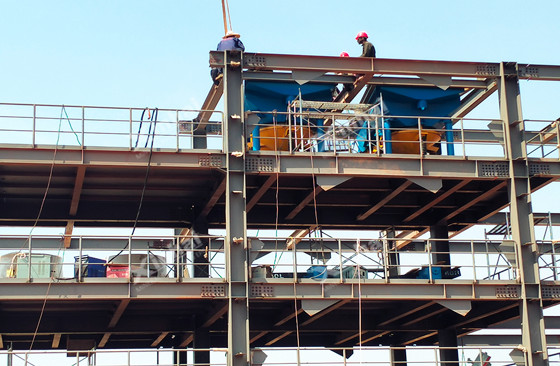
Equipment: Jig
Processing Size Range: The effective range for metallic minerals is 0.074-50mm. For placer gold, with a SG difference ≥1.25 and proper mineral liberation, the lower limit can reach 0.04mm. Advantages: Simple operation, high processing capacity, and excellent performance in roughing stages.
2. Gold Concentration Using Shaking Tables
The shaking table is the core equipment for cleaning placer gold concentrates. Its greatest strength is high separation precision, enabling further purification of rough concentrates from jigs, with concentration ratios reaching 50-100 times.
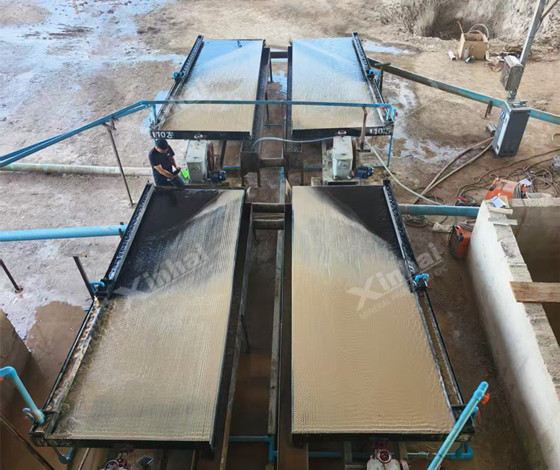
Equipment: Shaking Table
Processing Size Range: Ideal for finer particle separation. Tables are categorized into coarse sand, fine sand, and slime types based on feed size, typically handling material from 0.019-3mm.
Advantages: Stable and reliable performance, clearly visible concentrate bands, higher concentration ratios than other methods, easy operation, and the ability to produce a finished concentrate in a single pass.
3. Gold Sluicing
Spiral concentrators are widely used for recovering fine placer gold with low clay content (<10%), making them especially suitable for small-scale or temporary mining sites.
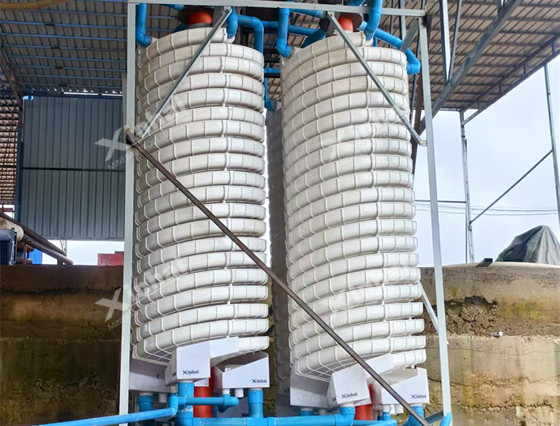
Equipment: Spiral Concentrator / Sluice
Processing Size Range: Effective for fine, low-clay materials, typically 0.03-0.6mm.
Advantages: Simple structure, high throughput, and low overall operational cost.
Unlike placer deposits, gold in vein ores is often disseminated within quartz veins or sulfide minerals, resulting in lower liberation degrees. Therefore, gravity separation is rarely used alone but is typically integrated with flotation and/or cyanidation in a combined circuit.
1. Gravity Separation - Cyanidation Combined Process
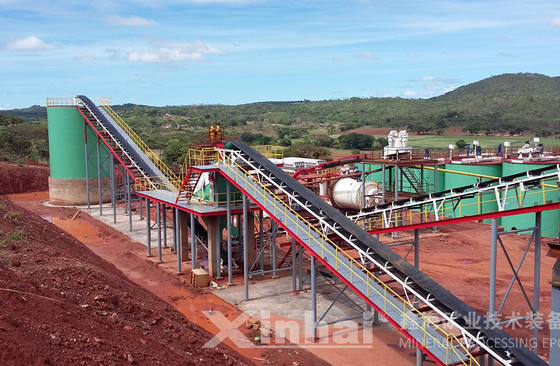
This circuit suits oxidized gold-bearing quartz vein ores. The core logic is to first recover coarse free gold, then leach the finer particles. The standard flow involves: ore passing through a jig for coarse gold recovery after crushing/grinding, followed by cyanidation of the jig tailings.
Ideal for processing oxidized gold-bearing quartz vein ores.
2. Gravity Separation - Flotation Combined Process
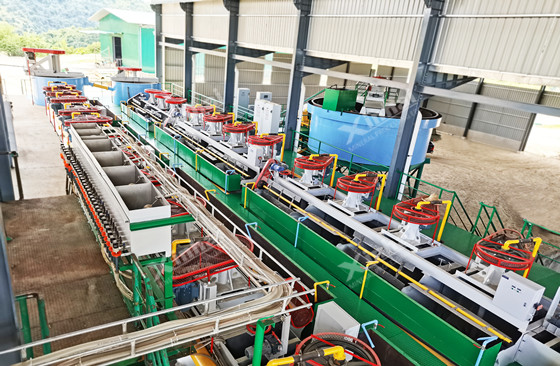
This process is most appropriate for vein gold ores associated with sulfide minerals like copper or lead. The flow involves: recovering coarse free gold from ground ore using a shaking table, followed by flotation of the table tailings to recover both gold and associated metals, enabling comprehensive resource utilization.
3. Flotation - Gravity Separation Combined Process
For refractory vein gold ores where gold is tightly bound and unevenly distributed within sulfides, a flotation-gravity circuit is effective. This involves first concentrating gold-bearing sulfides via flotation, then processing the flotation tailings with a shaking table to recover coarse gold missed by flotation.
Fifteen years of practice confirm: no reliable process flowsheet exists without proper ore testing. For both placer and vein gold deposits, detailed beneficiation test work by a professional institution is essential before finalizing the process.
Key analysis parameters include:
Gold particle size distribution in the ore
Degree of liberation
Specific gravity differences
Clay content
Associated mineralogy
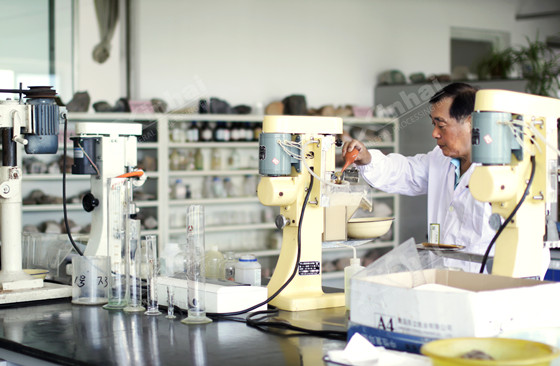
This data determines:
Whether gravity recovery is viable
If jigs or shaking tables are the primary method
The need for a combined process
The optimal grind size for liberation
Furthermore, equipment selection must holistically consider the mine's production scale, ore characteristics, and operational capabilities. Large-scale operations may opt for highly automated jigs and tables to boost efficiency, while smaller mines should prioritize simple, easy-to-maintain equipment to control costs.
Implementing a regular maintenance schedule is critical—for example, replacing jig diaphragms every 3 months and inspecting table decks every 6 months—to ensure equipment operates at peak performance.
Conclusion
Whether for placer or vein gold, the core principle of gravity separation remains: design the process based on ore characteristics, never force-fitting a standard flowsheet.
The fundamental rule for every gold processing engineer is to maximize recovery by fully utilizing the SG contrast between gold and gangue, selecting appropriate equipment, and executing with precision.
If you are planning a gold beneficiation circuit, we welcome discussions about your ore testing and process design needs. Our technical team is ready to provide you with a more reliable gravity separation solution.
Choose Xinhai Mineral Processing EPC—Your Professional Partner in Mining Engineering.
Share your project details and our engineers will get back to you shortly.
 CHAT
CHAT MESSAGE