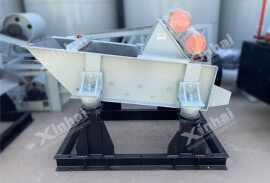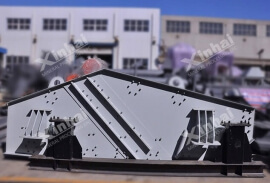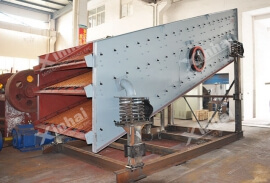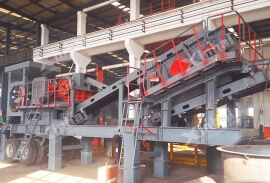

Vibrating screens are crucial equipment in the mineral processing flow, employed for efficient particle size separation through high-performance screening. Not only do they enhance the efficiency of the closed-loop process and ensure the safe operation of downstream machinery, but they also directly influence the final product grade for materials like iron ore, coal, gold, and lithium.
This guide offers an in-depth look at six types of mining vibrating screens. It covers their working principles, selection criteria, core designs, performance optimization strategies, and maintenance practices. Additionally, we will explore emerging trends and challenges in technology. Whether you're a field engineer, project decision-maker, or procurement expert, this information will help you make more informed, scientifically grounded screening solutions to boost overall production efficiency.
Basic Screening Mechanism
At the heart of vibrating screens operation is the rapid oscillation of the screen surface. An electric motor or exciter system generates this vibration, causing the screen to move at a set frequency and amplitude.
This vibration causes particles in the material layer to lift and rearrange. Finer particles naturally pass through gaps between larger particles, eventually reaching the screen's surface. When these particles encounter screen holes larger than their size, they drop through, becoming "undersized" material.
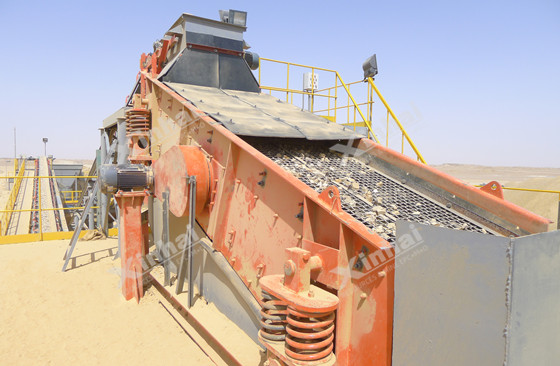
Larger particles, which cannot pass through the mesh, continue moving across the screen until they are discharged as oversized material. Screening is essentially a probabilistic process: the longer the material stays in contact with the vibrating surface, the higher the probability that smaller particles will find and pass through the mesh.
Main Components of a Mining Vibrating Screen
A typical vibrating screen consists of three essential components:
Screen mesh: The part responsible for separating material based on particle size.
Suspension system: Designed to minimize vibration and support the structure.
Motor-coupling-exciter system: This assembly generates the vibrational movement of the device.
Motion Types & Drive Systems
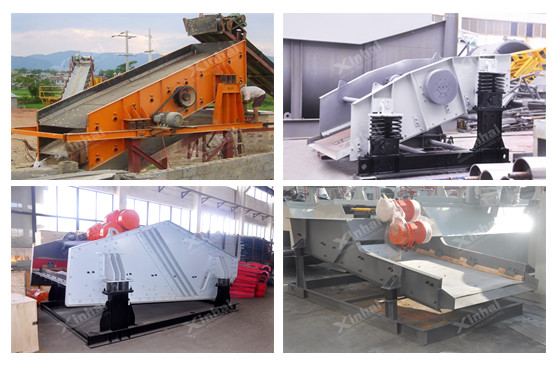
The movement of the vibrating screen can vary depending on the type of drive system used. These include circular (Round vibrating screen), linear (linear vibrating screen), elliptical (elliptical vibrating screen), and multi-stage variable inclination (banana screen).
Key parameters for screening performance include:
Amplitude: Typically between 5-15mm, influencing throw strength and throughput capacity.
Vibration frequency: Ranges from 800-3000 rpm, with higher frequencies used for fine particle screening.
Screen inclination: Between 10°-30°, which affects material advance speed.
g-value (acceleration multiplier): Between 3-7g, which determines stratification efficiency.
Screening efficiency is influenced by stratification, mesh penetration probability, and clogging. Under optimal conditions, finer particles pass through first, while coarser particles float upwards.
However, challenges such as high humidity or sticky materials can lead to clogging, reducing efficiency. Understanding these mechanisms is key to selecting and optimizing the appropriate equipment.
Vibrating screens come in various types, each with specific applications in mining and mineral processing. Below are six popular types:
This screen comprises a screen box, mesh, vibrator, and damping springs, driven by a motor that generates centrifugal force, making the screen vibrate and perform material classification. Known for high efficiency, low noise, and long lifespan, it's commonly used in mineral processing, coal, and construction material industries.
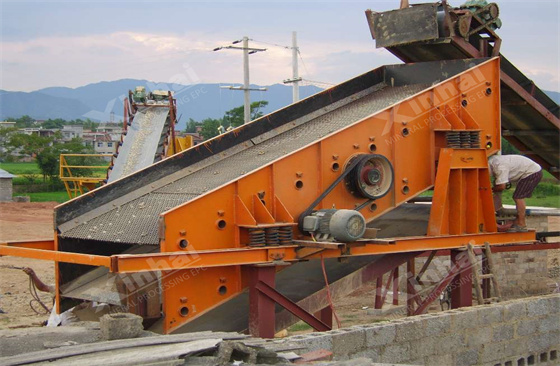
Available in single, double, or triple-layer variants, the most popular models are the YA and YK series. The YA series is suitable for simple structures and easy maintenance, while the YK series offers adjustable excitation force for smoother operation.
2. Auto-Centering Vibrating Screen
This screen uses a motor to rotate an eccentric main shaft, generating centrifugal inertial force that causes the screen to vibrate in a circular trajectory. It's robust, easy to maintain, and efficient. Featuring XinHai's exclusive durable rubber screens and springs, it extends the service life and reduces noise.
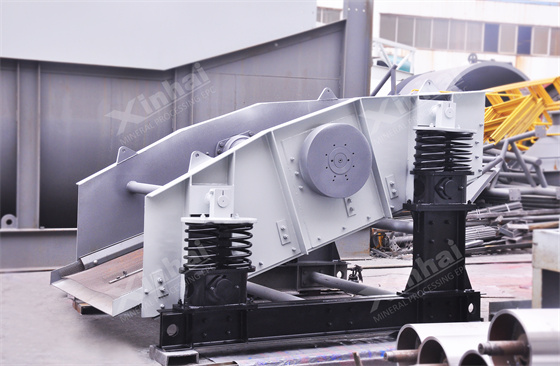
The large pulley and eccentric shaft produce a 3-5mm eccentric offset, ensuring stable transmission. This type is widely used in the mining, coal, metallurgy, and chemical industries for grading medium-to-fine particles.
This screen uses dual eccentric shaft exciters rotating in opposite directions, generating inertial force that cancels out in one direction but combines vertically to create linear motion.
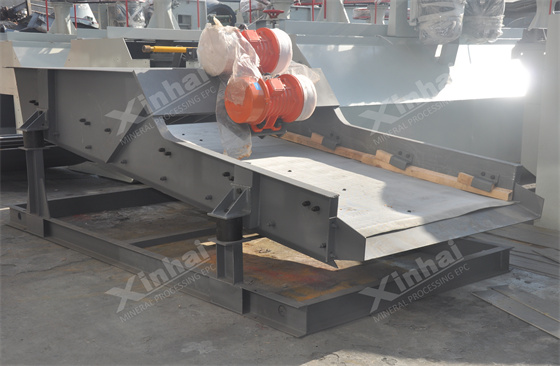
It's energy-efficient, with adjustable screen angles for higher throughput and cost-effective infrastructure requirements. It's especially effective for dewatering, mud removal, and medium-density separation in heavy media beneficiation processes.
4. Dewatering Screen
Dewatering screens operate using dual vibrating motors that work in sync to adjust excitation force. The result is linear motion of the screen, facilitating dewatering, mud removal, and medium separation.
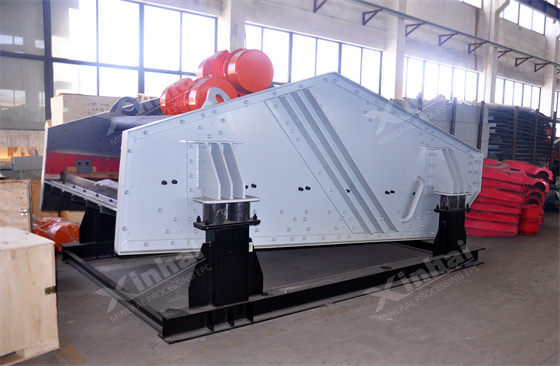
With a dual-stage design—one at a 5° angle and the other at 45°—it improves dewatering efficiency. It's highly effective in applications involving sand washing, coal slime recovery, and tailings dewatering in mining and construction industries.
5. Trommel Screen
A rotating cylindrical screen that flips and rolls material inside the drum. Fine particles pass through mesh holes, while coarser material moves forward and exits from the end of the drum. Known for smooth operation, low noise, and high throughput, it's ideal for processing large volumes of materials.
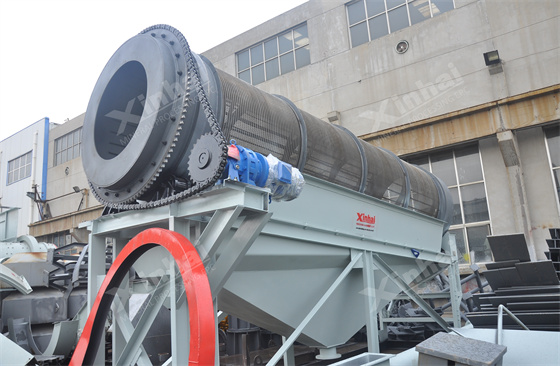
Heavy-duty models include scraper blades for better material dispersion. Widely used in aggregate, coal, chemical, and ore processing industries for material classification and ore washing.
6. Banana Screen
This innovative screening device features multiple layers of square mesh with progressively larger holes from top to bottom. The material's residence time on the screen varies according to particle size and the screen's inclination angle. With high throughput, efficiency, low energy consumption, and minimal maintenance, it's ideal for handling materials with high fine content. This screen is typically used in coal, mining, cement, and power generation industries for large- to medium-sized particle classification.
Quick Comparison of Common Screen Types in Mining
Type | Typical Amplitude/Frequency | Main Advantages | Main Disadvantages | Typical Mining Applications |
Circular Vibrating Screen | Medium Amplitude, Medium Frequency | Simple structure, large capacity, adaptable | Low efficiency for fine particles | Pre-screening and classification of coarse particles |
Linear Vibrating Screen | Large Amplitude, Low Frequency | High throughput, excellent dewatering capacity | Larger footprint, higher energy usage | Dewatering, fine particle classification in lithium ore |
High-Frequency Screen | Small Amplitude, High Frequency | Excellent fine particle separation, superior mud removal | Smaller capacity, shorter lifespan | Gold tailings recovery, lithium concentrate classification |
Banana Screen | Medium to Large Amplitude, Variable | High processing capacity, efficient, space-saving | Complex design, high maintenance cost | High-capacity classification for iron ore and coal |
Elliptical Screen | Adjustable Trajectory | Balances throughput and efficiency, good for sticky ores | Higher cost | Sticky ores like gold and lithium ores |
Fast Selection Guide for Typical Ores
Iron Ore (Coarse Particles): Opt for circular vibrating screens or banana screens.
Coal Dewatering: Prioritize linear vibrating screens.
Lithium/Gold (Fine Particles): High-frequency vibrating screens are best.
Material Moisture >8%: Consider anti-clogging or wet-screening designs.
Vibrating screens have high operational costs, with hourly losses potentially reaching thousands of dollars. Preventative maintenance is critical. Here is a checklist for routine inspections:
Bearing temperature < 70°C.
No unusual noises or oil leaks from the exciter.
Evenly tensioned and undamaged mesh.
No fatigue cracks in springs.
Maintenance schedule:
Weekly lubrication of bearings.
Monthly mesh wear checks.
Quarterly exciter inspections.
Annual comprehensive overhaul.
Common faults include:
Resonance/Polarization: Adjust exciter balance.
Screen box cracking: Reinforce welds or add braces.
Early bearing failure: Monitor vibration trajectory.
High-performance vibrating screens have become indispensable assets in modern mining, thanks to their:
High throughput and classification efficiency
Robust mechanical design and long service life
Flexibility to handle different ores, sizes and circuit configurations
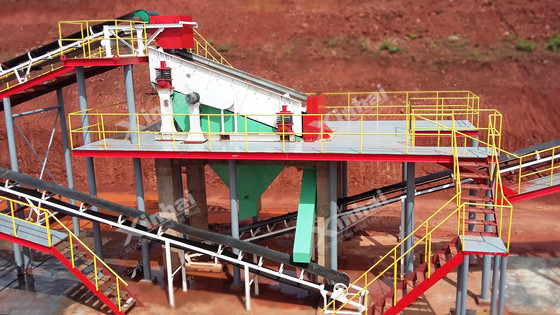
As a specialized mineral processing equipment manufacturer, Xinhai Mining is committed to delivering reliable, high-quality vibrating screens and complete screening solutions tailored to real plant conditions.
If you’re planning a new project or upgrading an existing plant, you’re welcome to share your ore characteristics and process targets.
Share your project details and our engineers will get back to you shortly.
 CHAT
CHAT MESSAGE